What We Are Actually Looking At When We Walk Your Yard
Most people expect the first visit to be a sales call. It is not, and it is not really a measuring exercise either. It is the only opportunity to find out what the job actually is before anybody writes a number down, and the reason we insist on it in Aliso Viejo is that landscape work cannot honestly be priced from a photograph.
Why a picture cannot answer the question
Grade, drainage, soil, access and whatever is buried in the yard decide the cost, and none of it is visible in a picture or over the phone. A photograph shows you the surface. Almost every variable that moves a landscape budget is either underneath that surface or is about how equipment and material get to it.
So a number produced from photographs is a guess, and it is always wrong in the same direction. It is low, because the guess is made without knowing what is under the ground, and the difference appears later as a change order. We would rather be slower at the start than have that conversation with you in week three.
We look at the whole lot, not the corner you called about
People usually call about one thing. A patio, a wall that is leaning, a dead lawn. The first thing we do is stop looking at it and look at everything else, because on a graded pad the thing that is bothering you is frequently a symptom of something happening twenty feet away.
A wall leaning is often a drainage question. A lawn that will not hold is often a soil and irrigation question before it is a planting question. A patio that puddles was usually built over a problem that predates it. Pricing the visible complaint without finding the cause produces a job that has to be done twice.
This is also why we ask to see side yards, back corners and the strip behind the garage that nobody has looked at properly in years. Those are where the evidence is.
The specific things we are checking
None of this is mysterious, and you are welcome to walk around with us and ask what we are looking at. Broadly it is these.
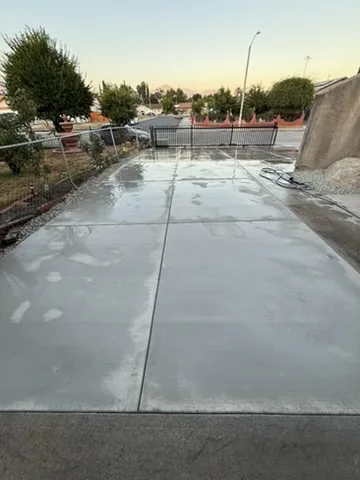
- The grade. Which way the ground falls, where the flat pad ends, and whether the falls still do what they were set up to do.
- Where water goes in a heavy December, which we work out from the shape of the ground and from what it has already left behind.
- Access. What can physically get into the yard, through which gate, and whether anything has to come out temporarily to make room.
- Soil and what is under it, as far as that can be read from the surface and from what is growing.
- What is already buried. Irrigation, conduit, old footings, and anything else nobody documented.
- Existing construction, including whatever is already holding ground, and whether it is doing that job properly.
- The boundary conditions, including how the pads above and below relate to yours.
Half of that list is invisible in a photograph and the other half is unreliable in one.
What we want from you during the visit
The most useful thing you can bring is not a plan. It is a straight account of how you actually use the space and what annoys you about it. Where you sit. Which door you use. What the yard is for in July compared with December. Which part of it you avoid and why.
The second most useful thing is honesty about phasing. If this is one project, that is one conversation. If it is the first of three, we design it as the first of three, and that changes what goes in the ground now.
Bringing pictures of work you like is genuinely helpful, with one caveat: they are useful as a description of the feeling you want rather than a specification. What works on a large flat lot is often the wrong answer on a compact graded pad, and part of our job is translating rather than copying.
Where phasing gets decided
Doing part of a project now and part later is common and it is often the sensible way to do it. What matters is which order the phases have to run in, because some things must happen while the ground is open.
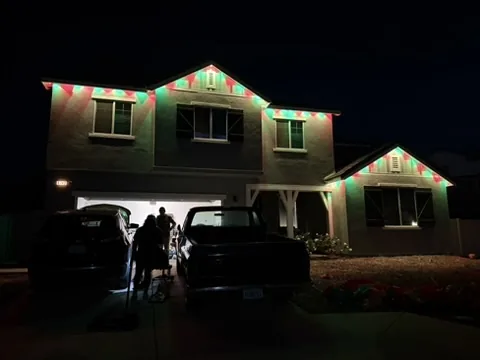
Running conduit and drainage now and building the surface next year is far cheaper than the reverse. So if lighting is a someday item, the wire goes in during this phase even though the fixtures do not, which is the kind of decision that only gets made properly if somebody asks the question on the first visit. Our lighting work in the area covers what that involves, and the same logic applies to irrigation and to any future paved area.
We would rather tell you to defer something than sell you all of it at once in the wrong order.
What you get afterwards, and what you do not
You get a written scope with base depths and materials named, so you can compare it against another bid line for line. That specificity is deliberate. It is what lets you see whether a cheaper bid is cheaper because it is more efficient or because it has left something out, and the thing left out is usually under the ground.
What you do not get is pressure. The visit is free and there is nothing attached to it. If the timing or the number is not right, come back when it is. We would rather do that than sell somebody a job they were not ready for, and we are not going to call you every week afterwards.
Then the job runs in a fixed order
If it goes ahead, the sequence is the same every time. Demolition, grading and drainage first. Then footings, walls and flatwork. Then planting, turf and lighting last, so nothing finished gets driven over and nothing has to come up again to run a pipe.
Grading, drainage, concrete, block, planting and lighting are all ours, so nothing waits on a subcontractor who is finishing somewhere else, and the finishes line up where two trades meet because the same people built both sides. At the end we walk it with you again, run the irrigation and the lighting, and clear the punch list before the final invoice rather than after it.
That closing walk is the same exercise as the first one, which is the point. It is the same people looking at the same ground, checking that what was described is what got built.
Booking one
We are based in Anaheim and get down to this end of the county regularly, so scheduling a visit here is routine rather than something we have to work around. Call (909) 567-5653 and we will arrange a time to walk the property, or tell us what you are picturing and we will come back to you.
If you want a sense of the finished work before you decide, the gallery is a better guide than any description. And if you are still working out what you want, that is a perfectly good reason to have us out. Get in touch and we will look at the yard with you.
Common questions
Is the first visit really free?
Yes. We walk the property, look at the grade and the drainage, and talk through what you want. The written scope follows. There is nothing attached to the visit.
How long does the visit take?
Long enough to see the whole lot and talk properly, which depends on the property and on how much you want to cover. It is not a five minute look at one corner, and it is not an all day survey either.
Do I need to know what I want before you come out?
No. Plenty of people call with a problem rather than a plan, and working out what the yard should do is part of the conversation. A clear account of how you use the space is worth more than a finished idea.
Can you look at work another contractor has done?
Yes, and we are asked to fairly often. We will tell you honestly whether it was built properly, what is causing whatever is going wrong, and what putting it right involves.
Want someone to look at yours?
We walk the property, check the grade and the drainage, and put a written scope together. The visit is free and there is nothing attached to it.