Light the steps so nobody misses one
Outdoor lighting for Brea homes: the front walk, the steps up to the door, the patio and the fire feature. Placed to show the ground clearly, aimed after dark, and kept off the neighbors’ windows on the hillside lots.
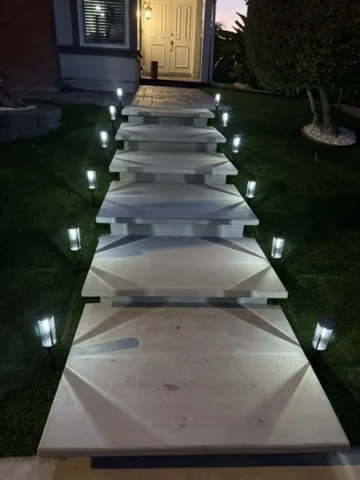
Start at the risers
Path lighting has one job before it has any other, and that job is showing people where the ground changes level. On the walk up to a front door the eye reads a flat pad easily in the dark. The edge of a step is harder. A riser lit from the wrong angle vanishes, and that is when a guest arriving at night catches a toe.
So the fixtures go low and sit beside each change in level, throwing light across the tread. The edge of the step then casts a small shadow, and that shadow is exactly what tells a foot where the step ends.
The door usually has its own light already on the house. Path lights handle the ground between the sidewalk and the porch. A stepped approach with pads set into lawn needs light on both sides, so the gap between one pad and the next reads clearly as grass and nobody steps into it expecting concrete.
Spacing that avoids the runway look
On a long flat walk, the most common mistake is two neat rows of fixtures down both sides at equal intervals. It lights the path the way an airport lights a runway, and it makes a front yard look smaller than it is. A short run of steps up to a door is different. There a light beside each step on both sides is the right call, because every edge needs to be seen.
Stagger them
On a long walk, fixtures offset from one side to the other give even light on the ground without parallel rows. The eye follows a soft line down the path.
Let the pools just meet
Each fixture throws a pool of light. We space them so the edges touch, which keeps the walk readable with fewer fixtures. Full dark gaps between pools are what make people slow down and squint at their feet.
Fewer, placed better
A walk with half the fixtures in the right spots looks calmer and shows the ground just as well. Where a tree or a planting bed deserves attention at night, one well aimed uplight does more than another path light would.
Stacked lots and the neighbor above you
The hillside lots in north Brea are stacked. The house above looks down into your yard, and you look down into the one below. On a flat tract lot a badly aimed light mostly annoys you. On a stacked lot it can shine straight into somebody’s bedroom.
We plan for that from the start. Fixtures along a slope or at the top of a retaining wall get shielded so light falls onto the ground and stays off the edge. Uplights near the rear of a pad are the usual offenders, since they point skyward and the neighbor above sits in exactly that direction. We use them sparingly there and angle them into the tree or wall they are meant to light.
Brightness matters as much as angle. A yard that glows can be seen from the whole hillside. Lower light, placed carefully, still gives you a usable yard after sunset, and the view from the houses above stays soft instead of harsh.
Around the fire bowl and the turf
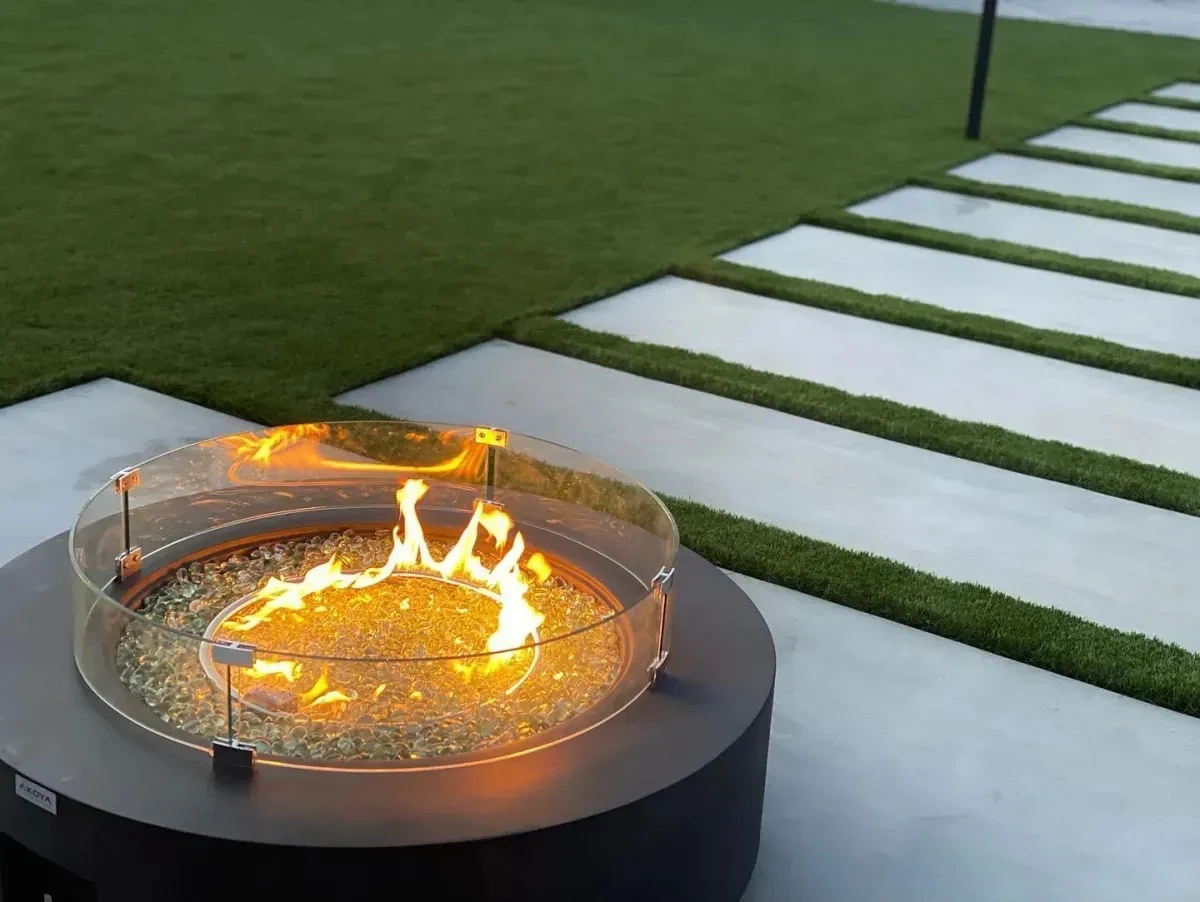
A fire feature is its own light source, and the lighting around it should leave room for that. Bright fixtures right next to the flames wash the fire out and make a seating area feel exposed. What that area needs is enough low light to find the chairs and the edge of the patio. The fire does the rest.
Patios built from long concrete panels with turf strips between them carry a particular trap. The turf reads dark at night, and the step from panel to turf is easy to misjudge. Low light along the panel edges fixes it. A lamp post or a light on a nearby wall can put a general glow over the whole area without anyone staring into a bulb.
Keep the controls simple: one circuit or schedule for the front path and another for the patio, so a late night by the fire does not leave the front walk lit until morning.
Wire goes in while the ground is open
The easiest time to add lighting is while somebody is already digging. When we build a patio, a walk or a wall, the ground is open anyway, and running conduit or sleeves under the new surface at that stage adds very little to the day.
Doing it afterwards leaves two choices: cut through finished paving or concrete to lay a wire, or route the wire the long way around. Neither looks as clean, and the first costs more than the sleeve would have.
So if lighting is anywhere in the plan, even a couple of years out, mention it on the walk-through for the hardscape. We run sleeves to where fixtures are likely to go, cap them, and note where each one ends so it can be found later.
Grading, concrete and low-voltage lighting are all done in house, which keeps that coordination simple. For a lighting job on its own, wire runs in shallow trenches through lawn and beds, and we put back what we disturb.
Aiming happens after sunset
Fixtures get set out during the day. They get aimed at night. In daylight you cannot see where a beam lands, how bright a pool looks on pale concrete, or whether a light is catching the neighbor’s window. We adjust each one after dark, with someone standing at the door and someone at the street.
That is also when we check the steps again. If a riser still reads flat, a fixture moves. At the end we walk it with you, run the lighting and the schedule, and clear the punch list before the final invoice.
Path lights along a lawn edge get bumped by mowers, dogs and kids over time. We set them back from the mowing line where the layout allows and show you how to re-seat one that gets knocked, because a stake leaning a few degrees throws its light somewhere else entirely and the step it was meant for goes dark.
Lighting is one of the services we run in Brea, and it often rides along with a patio or new turf. The county-wide version is on the outdoor lighting page.
Also in Brea:
Call (909) 567-5653, see the gallery, or tell us what you are picturing.
Lighting questions we hear on walk-throughs
How many path lights does a front walk need?
Fewer than most people expect. On a long walk we stagger them and space them so the pools of light just meet, then add one wherever the walk changes level. The count depends on the length of the walk and the number of steps, which we work out on site.
Will the lights shine into my neighbor’s yard?
They should not, and on a stacked hillside lot we plan specifically against it. Fixtures near a slope or a wall top get shielded and aimed down, uplights stay away from the rear edge, and we check every one after dark.
Can you add lighting to a yard that is already finished?
Yes. Wire runs in shallow trenches through lawn and planting beds, and we route around finished paving where we can. If a run has to cross a hard surface, we talk through the options with you before cutting anything.
Why do you aim the lights at night?
Because a beam cannot be judged in sunlight. At night we can see exactly where each pool lands, whether a step edge shows, and whether any light reaches a window. Aiming in daylight is guesswork, and it nearly always needs redoing.
Should I light around a fire pit?
Lightly. The fire gives off plenty of light when it is burning. Low fixtures along the patio edges and at any step onto turf are enough to move around safely, and they leave the fire as the thing people look at.
When is the best time to plan lighting?
Before any hardscape goes in. If we run conduit while the ground is open for a patio or walk, adding lights later is simple. Tell us on the first visit even if the fixtures are a year or two away.
Show us where it gets too dark
Tell us about the walk, the steps and the corners you avoid after sunset. We come out, walk the property with you, and write up where each fixture goes and why. No pressure attached.
Anaheim, CA. Locally owned. Financing available.
Ask us to come out
Leave the town and what you are picturing. We call back and come out.