Planting that reads finished the first season
Landscaping for compact Aliso Viejo lots, where the plan has to look complete on day one, survive the water rules, and pass HOA review before anything goes in the ground.
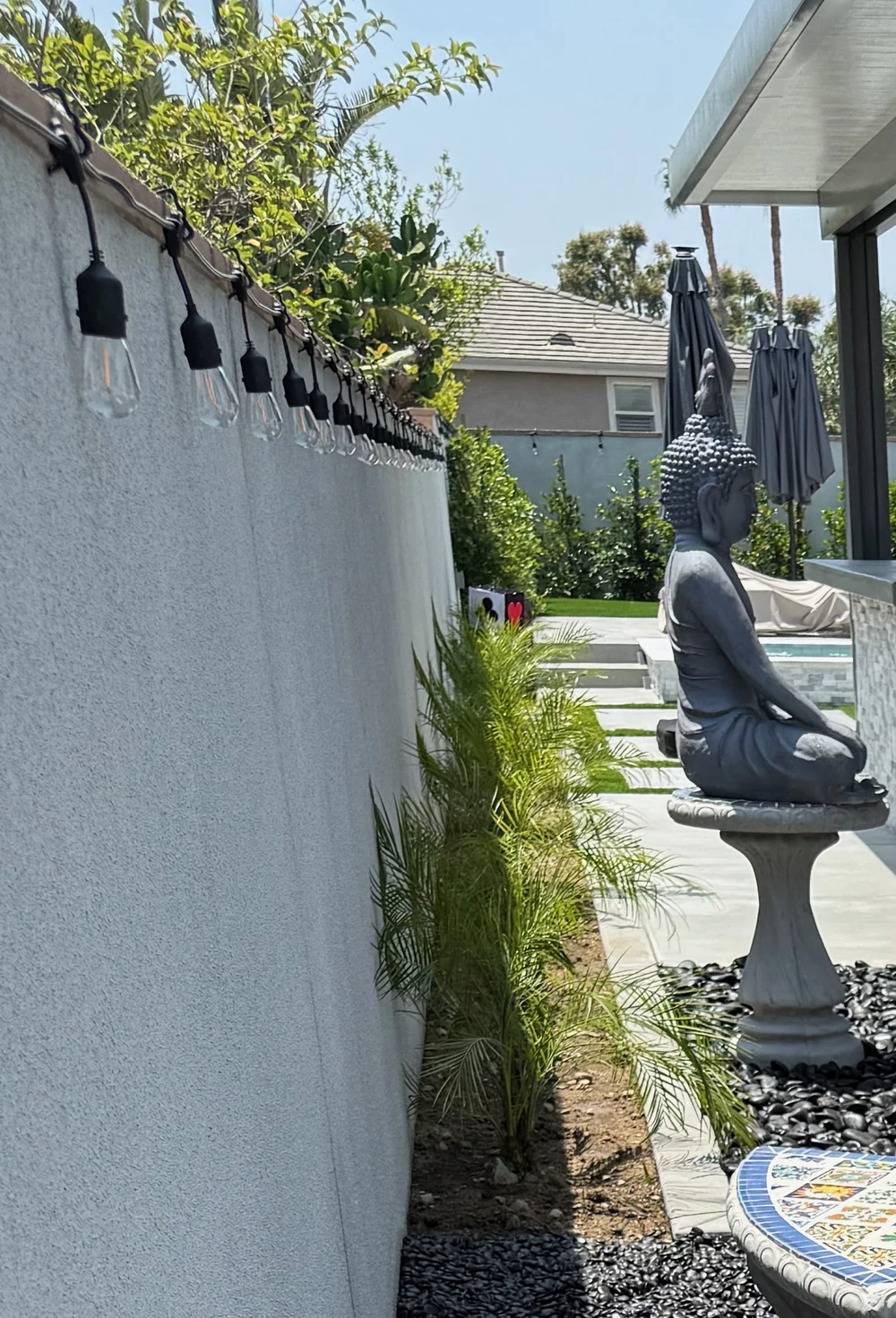
Small yards leave no room to hide
Every plant is visible from the door
On a compact lot there is no back forty to absorb a mistake. You see the whole planting from the patio slider, all of it, all the time. That changes what we recommend: fewer species, repeated deliberately, at sizes that hold their shape rather than a collection of one-offs that grow into each other by year three.
Mature size decides the plan
The single most expensive error on a small Aliso Viejo lot is planting something whose adult size the yard cannot carry. It looks correct for two seasons and then it is against the house, into the neighbor’s line, or shading out everything under it. We size from what a plant becomes, not from what fits in the pot today.
The HOA sees it before you do
HOA approval is part of nearly every job here, so we build to what the association will actually pass. That means we settle the plant palette, the hardscape material and the front-yard proportions on paper first, rather than installing something handsome that has to come back out because it was never submitted.
What we actually put in the ground
Layered planting, not a row of shrubs
Trees for structure and shade, then a middle layer of shrubs and grasses, then groundcover doing the work at soil level. Three layers is what makes a narrow bed read as a garden instead of a hedge with mulch behind it.
Beds shaped around the drainage
Where water crosses a graded pad, the planting has to accept it rather than dam it. We set bed lines and soil grade so runoff has somewhere to go, then plant to suit the wet corner and the dry one differently.
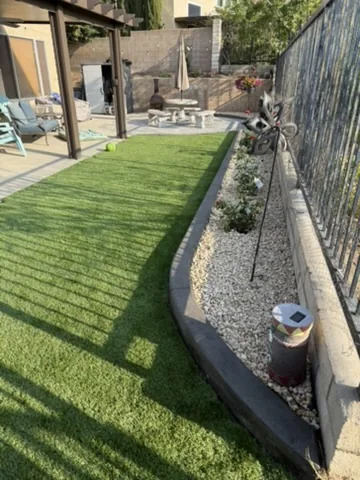
The water rules changed the plant list, not the ambition
Water cost and water restriction have reshaped what people ask for across this county, and drought-tolerant planting is now the majority of the planting work we do. Most of that is driven by the bill rather than by fashion. What it does not mean is a gravel field with three agaves in it, which is the version people picture when they hear the phrase and the reason some homeowners resist the whole idea.
A low-water garden on a small lot can be dense, layered and green. The change is which species carry the volume and how the irrigation is built to feed them. Drip conversion is usually part of the job, because putting a low-water plant palette on spray heads wastes most of what you are paying for and keeps the foliage wet in a climate that does not need the help.
Turf replacement is the other half of this conversation, and several water districts in the county have run rebate programs for it over the years. Terms change, so check with your own district before you build a plan around one.
Soil prep is the part nobody photographs
Planting into a graded tract pad is planting into ground that was engineered for a house, not for a garden. It was cut, filled and compacted to hold a slab, and what is left near the surface is often dense and shallow. Dropping plants into holes dug in that is why so much new planting looks tired by the second summer while somebody else’s looks established.
We loosen the planting zone rather than just the hole, amend to what the plant needs, and set the crown at the right height so it is not sitting in a bowl. On a compact lot this matters more, not less, because the same few plants carry the entire look and there is nothing else to distract from one that is struggling.
Irrigation goes in at the same stage, laid out by hydrozone so the thirsty corner and the dry slope are not on the same valve. Getting that wrong is what leaves half a yard overwatered and the other half dying while the controller says everything is fine.
Aliso Viejo, and what else we build here
This is one of the services we run in Aliso Viejo, and most jobs here combine several of them, which is the reason we keep the trades in house. The county-wide version of this service is on the landscaping page.
Also in Aliso Viejo:
Call (909) 567-5653, see the gallery, or tell us what you are picturing.
How a planting job runs
We come out and walk the property with you, look at the whole lot rather than the one bed you called about, and check the grade and where water goes in a heavy December. That visit is free and nothing is attached to it. Then you get a written scope naming the plants, the sizes and the irrigation, which is what makes it comparable line by line against another bid.
If the association needs a submittal, that happens before anything is ordered. Plants are a poor thing to buy speculatively.
On site the order is fixed: demolition first, then any grading and drainage, then irrigation mainline and valves, then soil prep, then planting from the largest material down to groundcover. Mulch goes on last so it is not walked through for a week.
At the end we walk it with you, run every zone in front of you so you can see the coverage, and hand over the plant list and the watering schedule. The first eight weeks of watering are different from the schedule the garden lives on afterwards, and we set both.
What happens after we leave
New planting is not finished planting. For the first couple of months the roots are still in the shape of the container, and the watering has to reach that shape rather than the wider bed. We leave you the schedule for that period and the one that follows it, and we would rather you call and ask than guess.
You get the plant list with the actual species on it, the irrigation zone layout, and the product details for anything with a manufacturer warranty behind it. That documentation is also what stops a future contractor from guessing at what is buried in your beds.
Workmanship is warranted. If something is not right, call us. We are a small local operation and our name is on work all over this county, which is a stronger incentive than any warranty document.
Questions about planting here
Will a low-water garden look sparse?
It does not have to. Sparse is a design decision, not a requirement of the plant palette. A dense, layered low-water planting is entirely achievable and it is what we build unless you specifically want the open, gravel-forward look.
Do I need HOA approval before you start?
Almost always here, and it varies by association. We design to what the association is likely to pass and we get the submittal settled before we order material, because plants are a poor thing to buy on speculation.
When is the best time to plant?
Planting establishes most easily in fall and early spring, when the roots get time to move before the heat arrives. We plant outside those windows too, it just means a more attentive watering schedule for the first season.
Can you keep some of what is already there?
Often, and it is usually worth it. An established tree is decades of growth you cannot buy back. We look at what is healthy and well placed on the first visit and design the new work around it.
Will you convert my sprinklers to drip?
Where the planting suits it, yes, and on a low-water plan it usually does. Running a drought-tolerant palette on spray heads wastes most of the water you are trying to save.
How long until it looks established?
The structure reads immediately because we plant to the spacing the design needs. Filling in is a matter of seasons and it depends on the species, which is a conversation we have while choosing them rather than afterwards.
Do you maintain the garden after planting?
Our work is design and installation. We hand over the plant list and both watering schedules so whoever maintains it is working from real information rather than from a guess.
Can you work on just the front yard?
Yes, and phasing is often the sensible way to do it. We will tell you which order the phases have to run in, because some things must happen while the ground is open.
What about the narrow side yard?
That strip is usually the most neglected part of a compact lot and it is often where the drainage runs. We treat it as real space, with a surface that stays walkable and planting that tolerates being in shade half the day.
Tell us what you are picturing
We will come out, walk the property with you and put a real scope together. No pressure attached to the visit.
Anaheim, CA. Locally owned. Financing available.
Have us walk it
Leave the town and what you are picturing. We call back and come out.