When artificial grass is the right call, and when it is not
Turf installation for Aliso Viejo yards. Straight talk on water savings, summer heat, drainage and pet use, so you know which side of that line your lawn falls on.
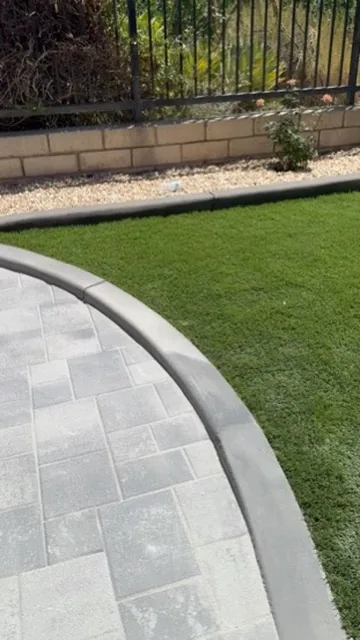
The case we will happily make for it
A lawn nobody uses is pure cost
If you are tired of lawn care, turf is the way to go. Plenty of small lots here carry a patch of grass that gets mowed, fed and watered and is otherwise walked past. Replacing that is usually a sound decision, and most people doing it are responding to the water bill rather than to a trend.
It stays green through the dry months
Turf that is installed properly drains well, feels soft underfoot and stays green all year without the hassle. Under permanent water restriction that is a real difference, because a live lawn on a restricted schedule spends part of every summer looking like it is losing.
Narrow and shaded spots suit it
The strip down the side of a house and the corner that never gets sun are the two places real grass reliably fails. Those are good candidates, because the failure there is a light problem that no amount of water or feed corrects.
Where we will tell you to keep the grass
Children who are on it every day
Replacing a lawn your children play on is a decision with more to weigh up. Synthetic surfaces run hotter in full sun than living grass does, and on a small yard with no shade that is the difference between a usable afternoon and one nobody spends outside.
A yard with an unsolved water problem
Turf over a drainage fault hides it rather than fixing it. If a corner already stands wet after a heavy December, that gets solved first. Otherwise you are paying to carpet the puddle.
Heat is the honest drawback
Nobody selling turf enjoys this part of the conversation, so here it is plainly: a synthetic lawn in direct afternoon sun gets hotter than the living lawn it replaced. That is physics, not a product defect, and no infill or blade technology makes it behave like grass on the hottest afternoons of the year.
What it means in practice is that placement matters more than product choice. A turf area that gets afternoon shade from the house, a tree or a structure is comfortable through the summer. One in the open middle of a west-facing yard with nothing over it will be avoided between roughly midday and evening, and you will have paid for a surface you use in the mornings.
So we look at where the shade actually falls on your lot before recommending an area, and on some yards the answer is a smaller turf area plus something overhead, rather than more turf.
Drainage is most of the installation
Turf is a permeable surface sitting on a base you cannot see, and that base is where the job is won or lost. Water has to get through the backing, through the aggregate and away somewhere deliberate. On the rolling ground here, with graded pads and side-yard slope, away means a route you chose rather than the fall of the pad toward whatever sits below it.
We excavate, install any drainage the grade calls for, then build and compact a base in layers with the fall set into it. The turf is stretched, seamed and fastened over that. Skipping the compaction is what produces the ripples and the low spots that show up in the first year, and they cannot be brushed out afterwards.
For dogs the base specification changes and the maintenance is different: the surface needs rinsing and the infill choice matters. It is entirely workable, it is just not the same build as a decorative lawn, and anybody quoting the same section for both has not asked the question.
Aliso Viejo, and what else we build here
Turf is one of the services we run in Aliso Viejo, and it is usually installed alongside something else on the same visit. The county-wide version of this service is on the turf page.
Also in Aliso Viejo:
Call (909) 567-5653, see the gallery, or tell us what you are picturing.
What installation week looks like
The old lawn and its root zone come out first, along with the irrigation heads serving it. Anything staying on that valve gets capped or re-plumbed then, rather than discovered later. If drainage work is needed it happens while the ground is open, because that is the only cheap moment to do it.
Base material goes in and gets compacted in layers, with the fall set deliberately. We check it with a straightedge rather than by eye, since a base that is close enough reads as a wave once a flat green surface is stretched over it.
The turf is cut to the shape, seamed where a roll join is unavoidable, and fastened at the edges. Seam placement is planned so joins fall where they are least visible rather than where the roll happens to end. Infill is brushed in and the pile is groomed up.
Then we walk it with you, show you the drainage points and the edges, and leave the product paperwork. Manufacturer warranties on the turf pass to you, and we tell you what the routine actually is: a brush now and then, a rinse where a dog uses it, and leaves off it before they mat down.
Money, rebates and what we will not promise
Several water districts in this county have run rebate programs for turf replacement over the years, and the terms change. Check with your own district before you build a plan around one, and do it before the old lawn comes out, because some programs care about the sequence.
We are not going to hand you a payback figure. Water use, lot size and what you were spending on maintenance vary far too much between houses for a number like that to mean anything, and any contractor quoting one confidently is quoting an average that is not your yard.
What we will give you is a written scope naming the base depth, the drainage and the product, so you can compare it line by line against another bid. That is where the real difference between two turf quotes usually hides.
Questions about artificial grass
Does it get hot in the summer?
In direct afternoon sun, yes, warmer than living grass. Shade is what solves it, so we look at where the shade falls on your lot before recommending where the turf area goes.
Is it good with dogs?
It works well, and the base specification is different from a decorative lawn. It needs rinsing where a dog uses it regularly, and the infill choice matters, so tell us at the first visit rather than after.
Where does the water go when it rains?
Through the backing and the aggregate base, then out along a route we set deliberately. On sloping ground that route gets designed, because the fall of a graded pad will otherwise decide it for you.
Will it look flat and fake?
The install decides that more than the product does. Ripples come from a base that was not compacted properly and visible seams come from careless seam placement, and neither can be corrected once the surface is down.
Do I need HOA approval to put turf in?
Usually here, and the rules vary between associations. We settle the product and the layout on paper first so it goes to the association before anything is ordered.
Can I put it over an existing patio?
That depends on what is underneath and how it drains. On a solid surface with no fall the water has nowhere to go, so we look at it before saying yes.
How long does an install take?
Most residential areas of this size are a short job once the ground is open, and the length depends on the demolition and any drainage rather than on the turf itself. We give you the days before we start.
What maintenance does it actually need?
A brush to lift the pile now and then, leaves cleared before they mat down, and a rinse where a dog uses it. It is far less than a lawn, it is not nothing.
Can you mix turf with planting?
That is usually the better answer on a small lot. A turf area framed by planting beds reads as a garden, where a wall-to-wall green rectangle tends to read as a surface.
Tell us what you are picturing
We will come out, walk the property with you and put a real scope together. No pressure attached to the visit.
Anaheim, CA. Locally owned. Financing available.
Have us walk it
Leave the town and what you are picturing. We call back and come out.