When the original patio has cracked and sunk
Paver patios, walks and borders for Brea homes, most often on the older flat tract lots where the first poured patio has broken up on clay. We rebuild the ground under it first, then lay a surface sized to the house.
Why the first patio gave up
Clay moves under it
The flat southern half of Brea sits on clay. It swells when it takes on water and shrinks as it dries, and it does that every year. A slab poured straight onto it decades ago has been lifted and dropped more times than anyone has counted.
Water had nowhere to go
Most of the tired patios we look at were poured dead flat or tipped toward the house. In a heavy December the water sits along one edge and soaks the clay under that side while the rest stays drier. Uneven wetting is what makes one corner drop.
The prep underneath
Nobody can see what went under a slab until it comes out. A thin base shows itself in how the pieces break, though: short sections tilted at odd angles rather than one clean crack. When we tear out, we look, and it tells us how deep the new section has to go.
How deep the base goes on ground that swells
There is no single depth we write on every job, and a bidder who names one without seeing the ground is guessing. A walk, a patio and a driveway carry different loads and need different sections underneath. On clay we also think about what water will do to the ground below that section, because a base sitting in a wet bowl of clay moves with it.
So the order goes like this. The old concrete comes out. We dig to the depth the use requires and shape the sub-grade so water sheds off it and away from the house. Aggregate goes in lifts, each one compacted before the next goes down. Dumping it all at once and rolling the top leaves a soft middle nobody sees until it dips.
Bedding sand is the thin layer the pavers sit in. It gets screeded to an even depth and it never gets used to hide a lumpy base. The fall, the depth and the compaction all go in the written scope, which is what lets you hold it up against another bid line for line.
Borders are what hold a paver field together
Pavers want to creep outward. Foot traffic, dragged chairs and a clay base shifting through the year all push the field toward whatever free edge it has. The border is where that stops.
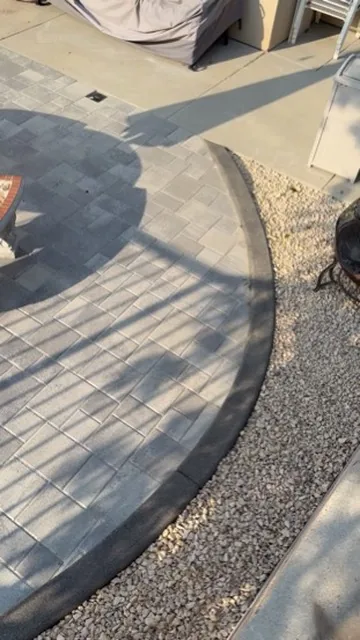
A soldier course frames it. A row of units turned lengthwise along the edge, often a darker color than the field, gives the patio a clean line and something solid to butt against. Behind it, edge restraint gets fixed down so the border row cannot walk either.
Where a patio meets a gravel bed instead of lawn, the border matters more. Gravel gives the edge no support at all, and it wanders onto the paving if the edge sits low. We set the border a touch proud of the gravel and keep the bed line clean so raking it stays easy.
Mid-century flat lots and the newer houses up the hill
For our purposes Brea has two kinds of houses. On the flat in the south are the mid-century tracts: low roofs, wide fronts, simple lines. To the north and east the hillside development is newer and usually bigger, sitting on cut-and-fill pads with a slope somewhere behind it.
Paving has to answer to whichever one it is attached to. Put a busy pattern in three colors behind a single-story tract house and it fights the building. A plain field, a modest unit size and one border color tend to look like they came with the house. The hillside homes can take larger units and a wider patio, but the pad edge and the retaining behind it set the limit before taste does.
Where new paving meets old concrete you are keeping, an exact match is rarely possible. Paver lines get discontinued and concrete never color-matches exactly. We would rather put in a deliberate transition, a band or a step, than a near miss that never quite matches.
Porch steps, entry walks and a column in stone
The front of a house gets looked at far more than the back, and on plenty of older tract homes the entry is the part that has aged worst. A cracked stoop. A walk that has lifted at a joint. A bare stucco post holding up the porch roof.
A refresh here is usually small and quick. We replace the walk and the step to the door on a proper base, and where a porch column is plain stucco we can wrap it in stacked stone veneer with a concrete cap on top. The cap sheds water off the top of the stone so it does not run down behind it.
Proportion counts most on an entry. One column in stone against white stucco looks intentional. Stone on every surface of a small porch is too much. We pick the stone and the walk material together so the front reads as one piece of work.

What the walk-through settles first
Nobody can price a patio honestly from a photo. What decides the job is buried or out of frame: how much old concrete there is and how thick, whether a sprinkler line runs under it, where the water goes, and how a machine gets from the street to the back yard.
So we walk the property with you, all of it, and look at the grade and the drainage along with the corner you called about. We check where the downspouts empty and which way the yard falls. On a tract lot we measure the side yard, since that is usually the only way in.
Then you get a written scope with the demolition, base depth, border and materials named. If drainage needs to go in, it is on the page. If lighting might follow next year, we will suggest running conduit while the ground is open. The visit is free and nothing is attached to it.
Hardscaping is one of the services we run in Brea, and a patio job often brings drainage, a low wall or new planting along with it. The county-wide version is on the hardscaping page, with patios and concrete flatwork covered separately.
Also in Brea:
Call (909) 567-5653, see the gallery, or tell us what you are picturing.
Patio questions from Brea homeowners
Can you pave over the old cracked patio?
We almost never do. A cracked slab on clay is still moving, and anything laid on top inherits every crack as it shifts again. Taking it out also lets us see what was underneath and set the new base to the depth the patio actually needs.
Pavers or a new poured slab?
Both work on clay when the base is right. Pavers flex a little as the ground moves, and a stained or broken one can be lifted and swapped. A slab gives an unbroken surface. On a flat tract lot either is reasonable, and we will tell you which suits the spot.
Why does a patio need a border at all?
Because pavers creep toward any edge that is free. A soldier course with edge restraint behind it holds the field square. Against gravel or a planting bed it also keeps loose material from spilling onto the paving every time it rains.
Will the new patio slope away from the house?
Yes. We set a fall so water runs away from the foundation toward a drain, a gravel bed or a planted area. On clay that detail matters more than almost anything else, since wet ground under one side is what makes a patio settle.
Can you match stone to an existing column or wall?
Sometimes. Stone and paver lines get discontinued, so an exact match is not always possible. When it is not, we choose something that works as a deliberate contrast and show it to you before anything is ordered.
Can the patio go in now and lighting later?
Yes. Tell us at the first visit and we will run conduit under the new paving while the ground is open. Cutting into a finished patio to run a wire later costs you more and never looks as clean.
Have us walk the lot
Tell us what the old patio is doing and what you want out there instead. We come out, walk it with you and write the scope. No pressure attached to the visit.
Anaheim, CA. Locally owned. Financing available.
Send us the yard
Leave the town and what you are picturing. We call back and come out.