Small yards need fewer lights, aimed better
Low-voltage lighting for compact Aliso Viejo lots, where your fixtures and your neighbor’s windows are closer together than the catalog photos assume. Seasonal roofline work too.
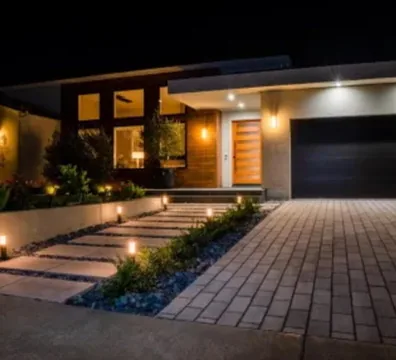
What a compact lot changes about the design
Your beam does not stop at the fence
On a tract lot the property line is close enough that a badly aimed uplight finishes its work in somebody’s bedroom. We pick mounting positions with the boundary in mind, use shielded housings, and check the throw from the neighboring side of the fence rather than only from your patio.
Fewer targets, chosen deliberately
A compact garden usually holds two or three things genuinely worth lighting: one tree with real structure, a wall with texture, a change in level. Lighting those and letting the rest sit dark makes the space read larger after dark. Lighting everything flattens it.
Cable routed around what is already in
These yards are rarely empty when we arrive. Irrigation, turf, an existing patio and a side return that is barely wide enough to walk all constrain where a cable can go. We plan the runs around them so the install does not become a demolition job.
Where the fixtures actually go
The front, seen from the street
Entry steps, the walkway edge, the house face and whatever tree is carrying the front garden. This is the part of the job the association and the neighbors see, so proportion matters more here than fixture count.
The back, seen from inside
Most of the year you look at the back garden through a window rather than standing in it. We aim for what reads well from the kitchen and the living room after dark, which is usually a lit wall or canopy rather than a lit lawn.
Grade changes are the opportunity
Aliso Viejo sits on rolling terrain with graded pads, so very few of these gardens are one flat plane. There is usually a step down to a terrace, a low wall between your pad and the neighboring one, or a bank at the back of the lot. Those level changes are the best thing you have to light, because light raking across a riser or a wall face gives you depth that a flat lawn never will.
They are also the safety argument. A step you know by daylight is a step you misjudge carrying something in the dark, and side-lighting the riser solves that without putting a bollard in the middle of a narrow path where it will be walked into.
Association rules, and asking before you buy fixtures
HOA approval is part of nearly every job we do in this city, and lighting is no exception. What the design rules cover varies between associations: some care only about anything mounted on the building face, some have a view on fixture finish or on brightness at the boundary, and some have nothing to say about low-voltage garden lighting at all. We do not guess at it, and you should be wary of any contractor who tells you what the rules are before reading them.
The practical order is to confirm what your own association actually requires for your address, then select fixtures, rather than the reverse. It is a short conversation early and an expensive one after the equipment is on site. Where a submission is needed we will give you what the design amounts to in writing so you have something to put in front of the committee.
Lighting in the wider service area
This page covers lighting work in Aliso Viejo. The full method, fixture types and controls are set out on the main outdoor lighting page, and we take the same work throughout Orange County.
Other work we do in this city:
Call (909) 567-5653, see the gallery, or tell us what you are picturing.
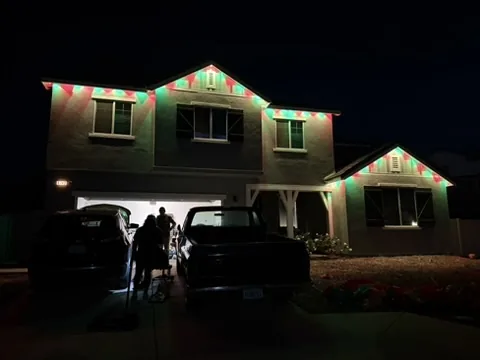
Holiday lighting on a two-story tract house
Seasonal roofline work is a different trade from garden lighting even though the same crew does both. On the two-story elevations common here the job is mostly about access and clips: getting to the line safely, fixing to the gutter or the shingle edge without leaving holes, and running the power to a point that is not an extension lead crossing the front path.
Booking runs through the fall for a November install, and the ones that go smoothest are the properties we have already been to, because the measurements and the power situation are known before the truck arrives.
Takedown is part of it. The lights come off, get boxed and stored, and the fixings come off with them rather than staying up until spring. If your association has anything to say about installation and removal dates, tell us at booking and we will schedule inside it.
The permanent low-voltage system and the seasonal display work together. Once conduit and an outdoor circuit are in for the garden lighting, the holiday install has somewhere to plug in that is not a window. What the seasonal service covers in full is on the Christmas light installation page.
Aiming happens after dark
Nothing about a lighting system can be judged at two in the afternoon. Fixtures get set in daylight and then aimed at night, which always means moving them from where they looked right earlier, and we walk the finished system with you in the dark so you can say that one is too bright before we leave rather than a week later.
Planting grows into beams. A tree lit tightly this year needs the beam widened or the fixture pulled back in two or three years, and a shrub that was knee height when we set the uplight will eventually sit in front of it. That is a short visit rather than a redesign, and it is worth expecting rather than being surprised by.
Timers and photocells drift with the seasons if they are set to clock time. An astronomic control tracks sunset through the year, which matters more here in December than it does in June, and it is the setting we leave systems on unless you want something else.
Questions from Aliso Viejo homeowners
Will the lights spill into next door?
Not if the aiming is done properly. On close-set lots we use shielded housings, tighter beam angles and mounting positions chosen with the boundary in mind, then check the result from the neighboring side after dark.
Does my association have to approve it?
Quite possibly, and it depends entirely on your own association. Some have rules covering anything fixed to the building, some address boundary brightness, and some say nothing about low-voltage garden lighting. Confirm what applies to your address before fixtures are ordered.
How many fixtures will a yard this size take?
Usually fewer than you expect. Compact gardens read better with a small number of well-aimed fixtures than with a fixture every few feet, and the second approach is what makes a lot look like a parking area.
Can lighting go in without tearing up the yard?
In most cases yes. Low-voltage cable sits shallow and can be routed through beds, along turf edges and around existing patios, so an established garden takes very little disturbance.
Can you light the steps between levels?
Yes, and on a graded lot that is usually the first thing worth doing. Lighting a riser from the side makes the level change legible without putting a fixture in the middle of a narrow path.
Do you do the holiday lights as well?
Yes. Seasonal roofline installs book through the fall for a November fitting, and takedown and storage are included rather than left to you in January.
What happens when plants grow into the beams?
They get re-aimed. Expect an adjustment visit every couple of years as planting fills in, which takes minutes per fixture and is not a redesign.
Can I add to the system later?
Yes, provided it was built with room to. We size the transformer with headroom and plan the cable runs so that adding fixtures in a year or two does not mean replacing what is already in the ground.
Do you work on the front and back together?
Usually, because they are one system even though they are two different jobs. Doing both at once means one transformer, one set of trenching and a schedule you can run on separate zones.
Tell us what you are picturing
We will come out after dark if that suits, walk the property with you and put a real scope together. No pressure attached to the visit.
Anaheim, CA. Locally owned. Financing available.
Have us walk it
Leave the town and what you are picturing. We call back and come out.