Planting that suits the ground it goes into
Landscaping for Brea homes, from the long side yard beside a stucco wall to the cut slopes behind the hillside houses. The soil gets prepared before anything goes in, and the water goes where the roots are.
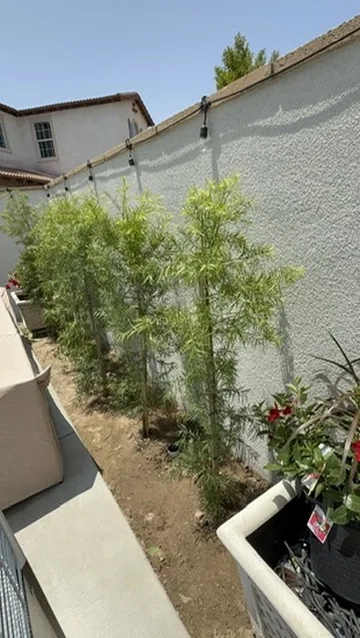
The side yard nobody planned for
A strip along a wall
On a Brea tract lot the side yard is often a long run between the house and a stucco wall or a fence. It gets sun at odd hours and it is where the trash cans live. A bed along the wall with a row of slender young trees turns it into something you actually look at from the kitchen window.
Pick trees for the width
Narrow has to mean narrow when the tree is grown. One that fits the bed on planting day and spreads wide a few years later ends up scraping the wall and leaning over the walk. We choose upright forms for these strips and space them so each one has room to fill in.
Leave the walk alone
The concrete walk is how you get from the gate to the back. The bed sits beside it and stays low at the edge so a bin still rolls past. Planting that spills over the path gets stepped on, and after that it gets pulled out.
Getting clay ready before the first tree goes in
Clay is the reason so many Brea beds look fine in March and struggle by August. It holds water for a long time after rain or after the sprinklers run, so roots sit wet. When it finally dries out it shrinks and cracks, tearing at the fine roots a young plant depends on. Both halves of that cycle are hard on anything new.
Prep starts by breaking up the compacted ground across the whole bed. Digging one hole per plant into hard clay and filling it with soft soil makes a pot with no drainage, where water collects and the roots circle inside. We work organic material through the full bed so the soil opens up and drains more evenly, and we check which way the bed falls so water can leave it.
Then planting height. A root ball set too deep in clay suffocates. Set slightly high, with the soil sloping gently down and away from the trunk, it sheds the extra water after a storm and stays healthy through the wet months.
Planting a cut-and-fill slope in north Brea
The hillside homes to the north and east sit on cut-and-fill pads, so somewhere on the lot there is a bank. North Brea lots back onto real slope, and what grows on it has work to do.
Roots bind the surface soil and slow water running down the face. A bank left bare loses a little ground every storm. We pick plants that root widely and set them in staggered rows so there is no straight channel for water to follow downhill.
The risk runs the other way too. A slope that gets saturated can slump, and an irrigation system left running too long is the easiest way to saturate one. On a bank we lay drip in short zones, water less often and more deeply, and keep the heaviest watering away from the top edge. If a retaining wall sits at the toe, the planting above it has to work with the drain behind that wall, which is one reason we plan the slope and the wall together.
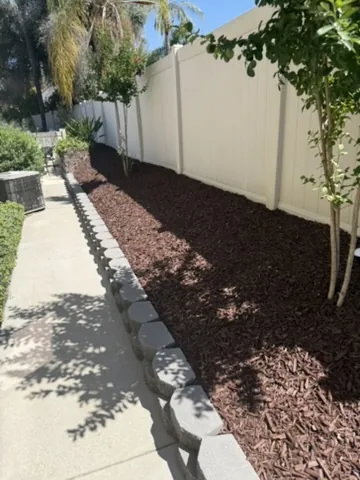
Drip lines and mulch, and why we use both
Spray heads on a narrow bed throw half their water onto the wall, the fence and the walk. Drip puts it at the base of each plant, slowly, so the clay has time to take it in. That slow delivery suits Brea soil better than anything else we install in a bed.
Mulch goes on top. A layer of bark keeps sun off the soil so it dries more evenly and cracks less. It holds down weeds, covers the drip line so the tubing lasts longer, and makes a new bed look finished on day one, well before the trees have filled in.
A low block edge between the mulch and the walk keeps the bark where it belongs. Without one, every rain and every leaf blower moves a little more of it onto the concrete, and within a season the bed looks thin.
Fall and early spring are the planting windows
Hardscape and concrete run all year here. Planting establishes most easily in fall and early spring, and we schedule around that wherever a client has the flexibility.
In fall the soil still holds summer warmth while the air cools, and rain, when it comes, does part of the watering. A tree planted in fall spends the winter putting down roots and meets its first hot summer with a head start.
Early spring is the second good window. Plants go in ahead of the heat and get a few months to settle. It fits neatly when a patio or wall finishes over winter and the beds are the last step of the job.
Keeping beds clear of the house and the drainage
A planting bed holds water. That is its job, and right against a foundation it is the wrong place to do it. We keep beds and drip lines back from the house wall and grade the soil so it slopes away.
Drainage paths matter just as much. If a side yard carries runoff from the back of the lot out to the street, a raised bed built across it becomes a dam. We find where water goes in a heavy December before we draw a single bed, and the planting fits around that route.
A new bed looks sparse on day one, and that is deliberate. Young trees and shrubs are spaced for the size they will reach, so the gaps close over the next couple of growing seasons and nothing ends up crowding its neighbor or the wall. Once the beds are in, we walk them with you, run each drip zone so you can see the emitters working, and show you where the controller is and how to change the schedule when the weather turns. Anything on the punch list gets cleared before the final invoice.
Landscaping is one of the services we run in Brea. The county-wide version is on the landscaping page, and on most jobs the planting arrives alongside a patio, turf, lighting or a wall built by the same crew.
Also in Brea:
Call (909) 567-5653, see the gallery, or tell us what you are picturing.
What people ask before we plant
What should go in a narrow side yard?
Upright trees or shrubs that stay slim when grown, a bed along the wall, and a walk left clear for bins and access. We look at how many hours of sun the strip really gets before choosing anything, since a tall wall can shade it most of the day.
Do I need to amend clay soil before planting?
Yes, across the whole bed. Clay holds water and then cracks as it dries. Breaking up the compacted layer and working in organic material helps it drain evenly, which gives young roots a far better start than one amended hole per plant.
Can you plant the steep slope behind the house?
Usually. We choose plants that root widely, stagger them across the face, and run drip in short zones so the bank never gets soaked. If a wall or a drain sits at the bottom, the planting plan works around it.
Drip or sprinklers for new beds?
Drip for beds and slopes. It delivers water slowly at the roots, which clay can absorb, and nothing lands on the wall or the walk. Spray heads still make sense on a real lawn, and one yard can have both.
When is the best time to plant?
Fall and early spring, when plants establish most easily. Hardscape and concrete can run year round, so on a combined job we often build the patio or wall first and plant in the next good window.
How far should planting stay from the house?
Far enough that irrigation is not soaking the ground against the foundation, with the soil sloping away from the wall. The right distance depends on the plant and the lot, and we mark it out with you on the walk-through.
Tell us about the side yard, or the slope
Show us the bare strip, the tired bed or the bank you worry about after a storm. We come out, walk the property with you and put the plan in writing. No pressure attached.
Anaheim, CA. Locally owned. Financing available.
Tell us the town
Leave the town and what you are picturing. We call back and come out.