When a Yard Needs Drainage Work Before Anything Else Gets Built
The most expensive mistake we see in this county is a good patio built on top of an unsolved drainage problem. The patio is fine. The problem is still there, and now it is under something you paid for.
How to tell if you have one
You do not need instruments. You need to look at the yard during and just after a heavy rain, which most people never do because that is exactly when nobody goes outside.
- Water standing anywhere more than a day after rain stops.
- Ground that stays soft and prints underfoot long after the rest has dried.
- A dark tide line on a wall or a fence where water sits against it.
- Soil, bark or gravel washed into a consistent fan shape, which shows the path water takes.
- Efflorescence, the white powdery deposit, low on a wall, which means moisture is moving through it.
- Plants that die in one specific spot no matter what you put there.
That last one fools people for years. A bed that kills everything planted in it is almost never a soil-nutrition problem. It is usually a bathtub.
Why it is worse on our soil
Inland Orange County is largely clay. Clay does not absorb water quickly. When it does absorb it, it holds it and swells, and when it dries out it shrinks and cracks. Water that lands on saturated clay does not soak in, it runs, and where it cannot run it sits.
Add a rainfall pattern of long dry months followed by a few heavy events, and you get yards where the drainage never gets tested for most of the year and then fails all at once.
Why building over it makes it worse
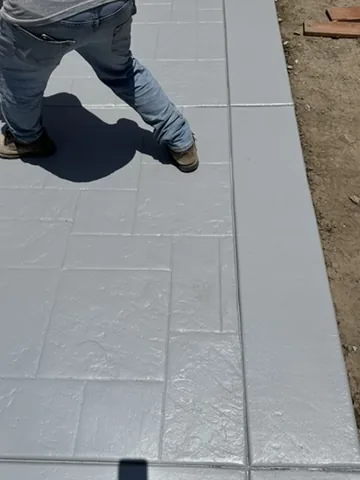
A patio, a slab or a turf lawn covers the ground. It does not remove the water, it redirects it, and unless somebody decided where it goes it will find somewhere on its own.
Usually that somewhere is the lowest available point, which on a suburban lot is frequently the side of the house. We have taken up patios that were poured with a slight fall toward the structure, which for eight months a year is invisible and for the other four is doing quiet, expensive damage.
Turf over a drainage problem produces its own version: the base stays saturated, the yard smells after rain, and the surface stays soft underfoot. The turf gets blamed. The turf is fine.
The fixes, roughly in order of how often they are the answer
Regrading
Often the whole solution and the cheapest one. If the ground falls the wrong way, changing the shape of the ground fixes it permanently, with nothing to maintain and nothing to clog. Where there is room to do this, it beats every piped solution.
Surface drains
Area drains at low points, or a channel drain across a patio edge or a garage approach, piped to somewhere useful. Simple, effective, and they need their grates cleared occasionally, which people forget until it backs up.
French drains
Perforated pipe in a gravel trench wrapped in filter fabric, intercepting subsurface water. Genuinely useful behind retaining walls and at the base of slopes. Frequently misapplied: a french drain in heavy clay with nowhere to discharge is a long thin hole full of water.
Dry wells and infiltration
These only work if the surrounding soil can accept water at a reasonable rate. In sandy coastal soil they work well. In dense clay they fill and stay full.
Downspout extensions
Unglamorous and often overlooked. A roof concentrates a great deal of water into a few points. If the downspouts discharge next to the foundation, no amount of yard grading downstream will help. Getting that water away from the house first is sometimes most of the fix.
Where the water is allowed to go
This is the constraint people do not expect. You cannot simply solve your drainage by discharging onto a neighbouring property. Cities have rules about where surface water may be directed, and the practical answer is usually the street, an existing drainage system or an area of your own property that can take it.
Working out the discharge point is part of designing the solution, not an afterthought once the trench is open.
The order of operations
Drainage and grading first. Then footings, walls and flatwork. Then planting, turf and lighting. Every time.
It is also cheaper this way. Solving drainage while the ground is already open, before there is a surface over it, costs a fraction of solving it afterwards. If you are planning any outdoor work and you know the yard has a water problem, deal with it in the same project rather than promising yourself you will get to it later.
A simple test you can run yourself
Dig a hole roughly a foot across and a foot deep in the area you are worried about. Fill it with water and let it drain completely. Then fill it again and time how long the second fill takes to disappear.
Fast, within an hour or two, and you have soil that accepts water. Slow, several hours, and infiltration solutions such as dry wells are unlikely to work well. Still holding water the next day and you have dense clay, and the answer is going to be moving water across the surface or through pipe rather than into the ground.
This is the same test that tells you whether a planting bed will drown things, and it takes ten minutes.
What the wet months actually do here
Our rainfall arrives in a small number of substantial events rather than steadily. That has a specific consequence: a drainage system sized for average conditions is undersized for the day it matters.
It also means the ground is frequently dry and hard when the first rain arrives, so the initial event runs off rather than soaking in, and the second event lands on ground that is now saturated. The two behave completely differently and the second one is where the damage happens.
We design surface fall and drain capacity for the heavy event. It is the only version of the design that gets tested.
Slopes, and why they concentrate the problem
On the hillside lots through the southern and eastern parts of the county, water arrives at the property rather than just landing on it. Runoff from above crosses the lot, and anything built across that path either passes it, diverts it or dams it.
An interceptor drain at the top of the property, or a swale that carries water around a built area, is often more useful than anything installed downhill. Fixing it at the bottom means handling the whole volume; fixing it at the top means it never concentrated in the first place.
Where the water is allowed to go
You cannot solve your drainage by directing it onto a neighbouring property, and doing so causes disputes that outlast the wet season. Practically, the discharge point is the street, an existing storm system, or an area of your own property that can accept the volume.
Establishing that point is part of the design. A drain line that ends optimistically in a gravel pit in heavy clay is a hole that fills up and stays full, and the drain above it stops working the moment it does.
The cost argument for doing it first
Drainage installed while the ground is already open, during demolition and grading, is a modest addition to a project. The same work retrofitted afterwards means breaking out finished surfaces, disturbing planting, and repairing everything you disturbed.
We have quoted the same drain line twice on the same property, years apart, and the second number was several times the first for identical pipe in identical ground. The only difference was that there was now a patio over it.
Common questions
How much does drainage work cost?
It depends entirely on the solution. Regrading, where there is room for it, is often the cheapest and the most permanent. Piped systems cost more and the price scales with the length of the run and how difficult the discharge point is to reach.
Will a french drain fix my yard?
Sometimes, and it is the most over-prescribed solution we see. A french drain in dense clay with nowhere to discharge is a trench full of water. It works well behind retaining walls and at the base of slopes where it has somewhere to take the water.
Can I redirect water to the street?
Usually, and it is frequently the correct discharge point. Cities have rules about how and where, so it is worth confirming the detail rather than assuming.
Do I need drainage if my yard has never flooded?
Not necessarily. What matters is whether the yard sheds water in the heavy events, not whether it has visibly flooded. If water stands for a day after a big rain, there is a problem worth solving before you build over it.
Want someone to look at yours?
We walk the property, check the grade and the drainage, and put a written scope together. The visit is free and there is nothing attached to it.