What Artificial Turf Actually Saves You in Water Over Five Years
The question we get asked most often about turf is not what it looks like. It is whether the water saving is real or whether it is a sales line. It is real, it is easy to work out for your own property, and it is smaller than some companies claim and larger than most sceptics expect.
Where the number comes from
A living lawn in this county needs a meaningful amount of water through the dry months, and the demand is not spread evenly across the year. It is concentrated between roughly May and October, when a cool-season lawn is under real stress and an irrigation controller is running long cycles several times a week to keep it green.
To work out your own number you do not need an industry average. You need two things: the square footage of lawn you are considering replacing, and your own water bills from last summer compared with last winter. The difference between a February bill and an August bill on the same property is mostly irrigation, and lawn is usually the largest part of that.
Do that comparison before anyone quotes you. It turns a vague claim into a number specific to your house, your soil and your controller settings.
The part nobody mentions
Turf does not use zero water. Rinsing it occasionally, particularly if you have dogs, uses some. But it is a rinse rather than an irrigation cycle, it happens a handful of times a year rather than several times a week, and it is a rounding error next to a lawn schedule.
What changes more than people expect is the rest of the garden. If a lawn is removed and the beds around it stay on the same controller programme, the controller is still running the schedule it was set for. We reprogramme the controller as part of the job, because a turf install that leaves the old irrigation schedule intact throws away a good share of the saving.
What the install actually costs you in year one
Turf is a front-loaded expense. You spend the money once and the running cost drops to nearly nothing. A living lawn is the opposite: cheaper to establish, and then a bill every month for as long as you own the house, plus mowing, plus fertiliser, plus reseeding the patches that die.
Whether that trade is worth it depends on how long you plan to stay. If you are selling in two years the arithmetic is different from someone who has been in the house twenty years and expects to be there twenty more.
Where the money really goes
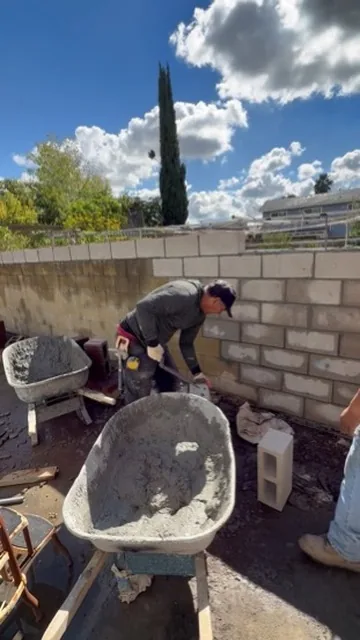
When people compare turf quotes, the difference is almost never the turf itself. It is the base. A correct install here means excavating several inches of existing soil, hauling it away, laying and compacting an aggregate base, screeding it flat, and only then rolling turf over it.
That is most of the labour and most of the material cost, and it is completely invisible once the job is finished. It is also the first thing a cheap bid removes. Turf on an under-prepared base looks perfect for one season, then develops low spots where feet travel, ripples along the seams and puddles that sit for days after rain. None of that can be fixed from the top. The turf comes up and the base gets redone, which means paying for the same job twice.
Three situations where we tell people not to do it
Under a heavy tree canopy that drops debris all year. The turf itself is fine, but you will be blowing it every week and the organic matter works into the infill.
On a steep bank with no way to anchor the top edge properly. Turf needs to be held at the perimeter, and a slope with nothing to fix into is a slope where the turf will eventually creep.
Where the lawn is genuinely used by children every afternoon and the yard faces full west sun. Turf in direct July sun runs hotter than living grass, and no product on the market eliminates that. Lighter infill helps, shade helps more, a rinse cools it quickly. But it is an honest trade-off and it should be made with the facts rather than around them.
Rebates are worth checking, and they change
Several water districts across the county have run turf replacement rebate programmes over the years. Terms, funding and eligibility change, sometimes mid-year, and they differ between districts even in neighbouring towns. Check with your own district directly before you plan around a rebate, and confirm whether the work has to be approved before it starts, because in some programmes it does.
The honest summary
Replacing a lawn you never walk on with turf or drought-tolerant planting is one of the more straightforwardly sensible things you can do to a garden in this county. Replacing a lawn your children play on is a decision with more to weigh.
If you want a number for your own property rather than a general one, we will come out, measure the area and go through it with you.
What changes between the coast and the inland tracts
This county is not one growing environment and the turf conversation shifts across it. On the coastal strip, from Seal Beach down through Huntington Beach and Newport, the soil is sandier and drains quickly, which makes base preparation more straightforward but also means a living lawn there is losing water through the profile as fast as it loses it to evaporation. Turf tends to pay back quickly.
Inland, through Anaheim, Fullerton, Placentia and Buena Park, the soil is clay. A lawn on clay holds water at the surface and the demand looks lower on paper, but the drainage work under a turf install is more involved because the base has to have somewhere to shed to. The saving is still real, the install spec is heavier.
Out in the hill communities, Mission Viejo, Laguna Niguel, Rancho Santa Margarita, the variable is slope. A sloped lawn is watering inefficiently by definition because a share of every cycle runs off before it soaks in. Those are frequently the properties where the water saving is largest and the least contested.
The maintenance costs people forget to compare
Water is the number everyone runs. It is not the whole comparison.
- Mowing, either your time every week through the growing season or a service.
- Fertiliser and weed control, several times a year.
- Reseeding or patching the areas that die: the dog run, the gate approach, the strip along the driveway that always burns out.
- Irrigation repairs. Spray heads get run over, cracked and buried, and a lawn system has a lot of heads.
- Aeration and dethatching on a lawn that is being kept properly.
Against that, turf has a rinse and an occasional brush of the traffic lanes. That gap is the part that compounds over the five years, and it is why people who make the switch rarely go back even when the water arithmetic alone is marginal.
What we do with the irrigation you already have
We do not cut and bury the lines. Zones serving the removed lawn get capped properly at the valve so there is nothing left to leak underground, and any zone still serving beds gets checked, re-headed where the planting has changed, and the controller reprogrammed.
That last step is the one most installs skip. A controller still running a lawn schedule for beds that no longer need it wastes a good share of what the turf just saved you, and nobody notices because the bill still went down.
Questions worth asking any turf installer
- How deep is the excavation and what is being hauled away?
- What base material, at what compacted depth, and compacted in how many lifts?
- Is there a drain line, and where does it discharge?
- What infill, and why that one for this use?
- How are the edges anchored?
- What happens to the existing irrigation and who reprograms the controller?
The answers to those six questions tell you far more about what you are buying than any spec sheet about the turf itself.
Common questions
Does artificial turf increase my property value?
It depends who is buying. Buyers who want low maintenance and a low water bill see it as an asset. Buyers with a strong preference for a living lawn see it as something to remove. In this county, where water cost is a standing conversation, it is more often read as a plus than a minus, but treat that as a secondary benefit rather than the reason to install it.
How long does an install take?
On a prepared yard of modest size, a couple of days. Most of that time is excavation, base placement and compaction rather than laying turf, which is the quickest part of the job.
Can I install turf myself?
You can lay turf yourself. What is hard to do without equipment is the excavation, the haul-away and the compaction, and those are the parts that decide whether it stays flat. Most failed DIY turf we are asked to fix failed underneath, not on the surface.
Will it fade?
Quality turf carries UV stabilisers and holds colour for many years. Cheap product fades noticeably, and it tends to fade unevenly, which is worse than fading uniformly. This is one of the places where the product specification genuinely matters.
Want someone to look at yours?
We walk the property, check the grade and the drainage, and put a written scope together. The visit is free and there is nothing attached to it.