What to Do With the Narrow Side Yard on a Brea Tract Lot
Almost every tract lot on the flat in south Brea has one: the long, narrow strip between the side of the house and the fence or the neighbor’s wall. It is where the trash cans live, where the hose ends up, and where people stop looking after a year or two. It is also the route every wheelbarrow, mower and bag of mulch takes to the back yard, and the place roof water has to get past the house. That makes it worth planning properly, even though nobody ever sits in it.
Start with what has to get through
Before anything gets planted, work out what needs to move along the side yard and how much room it takes. Trash cans have to roll to the street every week. A mower has to reach the back. If you ever want a patio or a wall built behind the house, the material and at least some of the equipment will come down this strip, because on most tract lots there is no other way in.
So we measure the clear width at the tightest point, which is usually a gas meter, an air conditioning unit or a gate post, and not the open stretch in the middle. That pinch point decides what fits. A bed that leaves plenty of room along most of the run but narrows to nothing at the meter has cost you the whole side yard.
Gates matter too. What can physically get into the yard, through which gate, and whether anything has to come out temporarily to make room are questions we ask on every first visit. A side yard planted without asking them tends to get dug up again the first time the back yard needs work.
The strip against the house wall is a water question
The ground right against the house is the most important few feet of the side yard, and the least forgiving. Roof water comes off the eave and lands there. On flat clay that water does not run off quickly. The clay takes it on and swells, then shrinks and cracks as it dries, and it does that right beside the foundation.
That is why we are careful about what goes against the house. Beds that get watered every day, soil heaped up against the stucco, and mulch piled over the base of the wall all hold moisture exactly where you do not want it. Keeping planting clear of the foundation, and clear of the path water needs to take, is the first rule for this strip.
The better arrangement is usually a surface next to the house that sheds water away from it, with planting on the far side against the fence or wall. Where the side yard has no real fall at all, a drain line may be the only honest fix. We work out where water currently goes in a heavy December before we suggest anything, because a side yard that floods will ruin whatever you put in it.
Side yard soil is usually the worst on the lot
Side yards collect whatever was left over when the house was built and whatever has been dumped there since. Broken block, old concrete, gravel from a path that disappeared long ago, and clay that has been walked on for decades until it is packed hard. Planting straight into that is how a row of new trees sits for two years and never grows.
So soil prep comes before planting. Compacted ground gets broken up, debris comes out, and the bed is built to take water in and let it move on instead of holding it around the roots. Clay holds water, then cracks when it dries, and roots do poorly in both halves of that cycle.
We also look for what is buried. Irrigation lines, conduit and old footings turn up in side yards more than anywhere else, because the strip was always the easy place to run things. Finding them before digging is a lot cheaper than finding them with a shovel.
If the soil is poor enough, a smaller bed done properly beats a long one done in a hurry.
A planting strip that stays in its lane
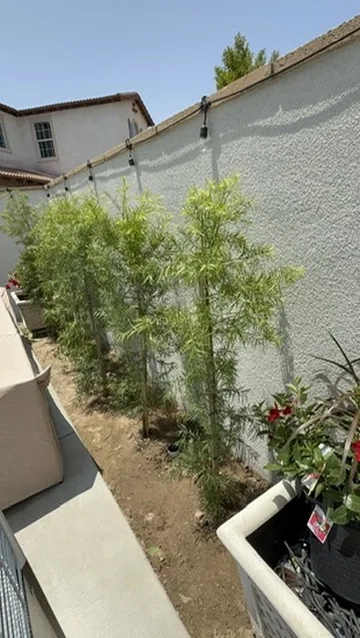
Once the access and the water are sorted, the planting strip itself is simple, and it should stay simple. Along a fence or a tall stucco wall, a single row of slender trees or upright shrubs gives the side yard some height without eating the walkway. Wide, spreading plants look good for a season, then lean across the path and get hacked back every month.
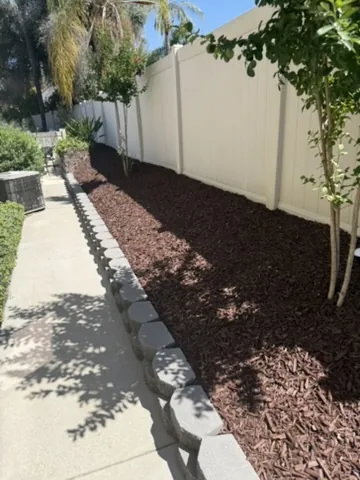
Low block edging keeps the bed where it belongs. It holds the mulch off the walk, gives the cans a clean line to roll along, and stops the bed creeping wider each year. Bark mulch over the soil keeps moisture in and weeds down, and drip irrigation puts water at the roots instead of spraying the walls and the walkway.
Timing helps as well. Planting establishes most easily in fall and early spring, which gives new trees a mild stretch to settle in before summer.
Our landscaping work in Brea goes further into plant choice. For a side yard, the rule is to pick plants for the width you actually have.
Deciding how much stays walkway
The last decision is the one people skip: how much of the side yard stays open. Our view is that the walkway is the main use of the space and the planting is the trim, so we size the path first and give the bed what is left.
The walk surface depends on how the strip gets used. Concrete handles cans and wheelbarrows well and sheds water if it is set with a fall away from the house. Pavers, or a gravel path with a solid edge, work where the traffic is lighter. A walkway, a patio and a driveway need genuinely different sections underneath them, and a side walk that takes a loaded wheelbarrow every week needs a proper base of its own.
Some side yards also need a wall, usually where one lot sits a little higher than the next or where a block wall is going up between two houses. That work happens before planting, because it takes the most room and makes the most mess. Our retaining wall work covers how those get built in tight spaces.
Then the order is the usual one: walls and drainage, then the walk, then planting last.
A side yard is a small job and a useful one. If yours has turned into a storage strip or a mud channel, we are glad to look at it, and we work across Brea regularly. Call (909) 567-5653 or tell us what you are picturing. The gallery shows finished beds and walks.
Side yard questions we hear
How wide should the walkway be?
Wide enough for the widest thing that has to use it, measured at the tightest point along the run. That is usually a trash can or a wheelbarrow, and the pinch is usually a gas meter or a gate post. We measure on the visit and size the bed around what is left, rather than the other way around.
Can I plant right up against the house?
We advise against it on clay. Watered beds and heaped soil against the stucco hold moisture beside the foundation, and the clay swells and shrinks with it. A surface that sheds water away from the house, with planting against the fence or wall, is usually the better layout for a narrow strip.
Is a side yard worth doing on its own?
Often, yes, but think about the back yard first. If a patio, wall or turf job is coming later, the material will probably come down this strip. Doing the side yard last, or at least leaving the access open, saves you digging up a new bed just to let the work through.
Side yard you have stopped using?
We walk the property, check the access and where the water goes, and put a written scope together. That first look is free, with no obligation attached.